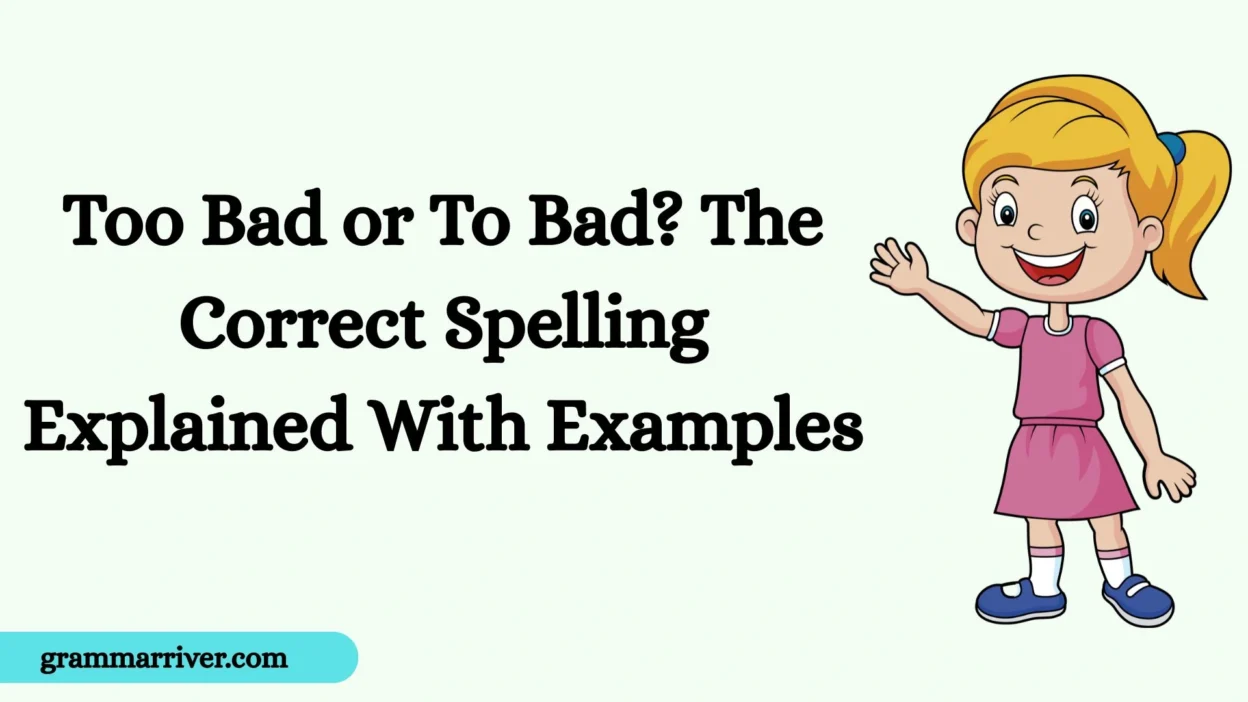
Too Bad or To Bad is a question many people ask. Have you ever stopped while writing and wondered whether you should write too bad or to bad.
Thousands of English learners, students, writers, professionals, and native speakers search these words because they sound exactly the same, making them easy to confuse, especially in everyday communication. From my experience, this common confusion stems merely from phonetic similarity, yet the fundamental grammar distinctions become clear once you know the difference. The good news is that the correct phrase is usually too bad, an idiomatic expression used to show sympathy, disappointment, or an unfortunate situation, while to bad is almost every case an incorrect mistake.
This guide explains why the correct phrase is used, where it came from, how British and American English use it, and which common mistakes to avoid. The meaning can alter when a grammatical distinction is overlooked, and that may compromise effective communication. On the other hand, that’s too bad expresses sympathy or indifference, depending on the sentence, but to bad should only appear separately when another reason requires to and bad to stand apart. We all have couldn’t go moments, and plenty of real-life examples represent this significant point for every learner, student, writer, professional, and speaker. Many others look for a simple answer, answers, better spelling, and clearer work by the end.
Too Bad or To Bad: Which One Is Correct?
The short answer is simple:
Too bad is correct.
To bad is usually incorrect.
When you want to express disappointment, sympathy, regret, or describe an unfortunate situation, the correct phrase is too bad.
Quick Comparison
| Phrase | Correct? | Meaning |
| Too bad | Yes | Unfortunate, disappointing, regrettable |
| To bad | No | Usually a grammar mistake |
| That’s too bad | Yes | Expression of sympathy or disappointment |
| It’s too bad | Yes | Describing an unfortunate situation |
Examples
Correct:
- That’s too bad you couldn’t come.
- It’s too bad we missed the train.
- Too bad the weather ruined our plans.
Incorrect:
- That’s to bad you couldn’t come.
- It’s to bad we missed the train.
The phrase too bad has been a standard part of English for centuries. Writers, speakers, journalists, and educators consistently use this form because it follows proper grammar rules.
What Does “Too Bad” Mean?
The phrase too bad expresses disappointment, sympathy, regret, or acknowledgment that something unfortunate happened.
In everyday conversation, people use it when events don’t go as planned.
Common Meanings of Too Bad
Disappointment
“Too bad the concert was canceled.”
Sympathy
“Too bad you got sick during your vacation.”
Regret
“It’s too bad we didn’t start earlier.”
Acceptance of an Unfortunate Outcome
“Too bad. We tried our best.”
The phrase often acts as a quick emotional response. Instead of giving a long explanation, someone can simply say “too bad” to communicate that a situation is unfortunate.
Everyday Situations Where People Use Too Bad
- Missing a flight
- Losing a game
- Failing a test
- Canceling plans
- Missing an opportunity
- Experiencing bad weather
- Not getting a desired job
For example:
“I didn’t get the promotion.”
Response:
“That’s too bad.”
In just three words, the speaker communicates understanding and sympathy.
Why “Too Bad” Is Correct
To understand why too bad is correct, you need to know what the word too means.
Meaning of “Too”
The word too can mean:
- Excessively
- More than desired
- Also
- Additionally
Examples:
- Too hot
- Too cold
- Too expensive
- Too loud
- Too difficult
In these examples, too intensifies the adjective that follows it.
The same principle applies to too bad.
Here, too emphasizes the negative quality represented by the word bad.
Grammar Breakdown
Let’s examine the phrase:
Too + Bad
- Too = excessively or very
- Bad = unfavorable or unfortunate
Combined:
Too bad = very unfortunate
This structure follows a common English pattern:
| Phrase | Meaning |
| Too expensive | More expensive than desired |
| Too slow | Slower than desired |
| Too late | Later than desired |
| Too bad | More unfortunate than desired |
The phrase became so common that native speakers often treat it as a fixed expression.
Why “To Bad” Is Usually Wrong
Now let’s look at the word to.
What Does “To” Mean?
The word to serves several grammatical purposes.
Most commonly, it acts as:
A Preposition
Examples:
- Go to school
- Walk to work
- Travel to Canada
- Drive to the airport
Part of an Infinitive Verb
Examples:
- To run
- To eat
- To write
- To learn
Notice something important.
In none of these examples does to function as an intensifier.
That’s why to bad sounds incomplete and grammatically incorrect.
Why the Phrase Doesn’t Work
Consider this sentence:
“To bad we missed the movie.”
The word to has no grammatical purpose here.
It doesn’t connect to a destination.
It doesn’t introduce an infinitive verb.
It simply doesn’t belong.
The correct sentence is:
“Too bad we missed the movie.”
Side-by-Side Comparison
| Incorrect | Correct |
| To bad you were late. | Too bad you were late. |
| To bad it rained. | Too bad it rained. |
| To bad they lost. | Too bad they lost. |
| To bad we couldn’t attend. | Too bad we couldn’t attend. |
The Real Reason People Write “To Bad”
This mistake occurs because English contains many words that sound identical but have different spellings and meanings.
These are called homophones.
Examples of Common Homophones
| Word | Confused With |
| To | Too |
| Their | There |
| Your | You’re |
| Its | It’s |
| Than | Then |
| Hear | Here |
When speaking, most people cannot hear the difference between to and too because pronunciation remains virtually identical.
As a result, writers sometimes choose the wrong spelling.
The mistake is understandable. However, proper writing requires selecting the correct version based on meaning rather than sound.
An Easy Trick to Remember the Difference
Fortunately, there’s a simple memory trick.
The Extra “O” Rule
The word too contains an extra letter.
That extra “O” represents something extra.
Since too means:
- Excessively
- More than enough
- Additional
The extra letter makes perfect sense.
Remember This
Too has an extra O because it means something extra.
Examples:
- Too much
- Too many
- Too expensive
- Too difficult
- Too bad
Whenever you want to express “more than desired” or “unfortunate,” use too.
Quick Test
Which sentence is correct?
- To bad you missed it.
- Too bad you missed it.
Answer:
Too bad you missed it.
The memory trick works almost every time.
Read More:Moreso or More So? The Right Choice Explained With Grammar Rules?
Is “Too Bad” Formal or Informal?
The phrase too bad works well in casual conversation. However, its level of formality depends on context.
Informal Usage
Most people use too bad in everyday speech.
Examples:
- That’s too bad.
- Too bad we missed lunch.
- It’s too bad she moved away.
These sound natural and friendly.
Professional Usage
In professional writing, more formal alternatives often sound better.
For example, instead of:
“Too bad the project failed.”
You might write:
“Unfortunately, the project did not succeed.”
Formal Alternatives
| Casual Expression | Formal Alternative |
| Too bad | Unfortunately |
| Too bad | Regrettably |
| Too bad | It is unfortunate |
| Too bad | It is disappointing |
| Too bad | Sadly |
Example
Casual:
“Too bad the meeting was canceled.”
Formal:
“Unfortunately, the meeting was canceled.”
Both are correct. The choice depends on audience and setting.
Common Phrases That Use “Too”
Learning similar expressions helps reinforce the correct spelling.
Too Much
Meaning:
More than desired.
Example:
“The coffee contains too much sugar.”
Too Many
Meaning:
Greater quantity than desired.
Example:
“There are too many people here.”
Too Late
Meaning:
Past the appropriate time.
Example:
“We arrived too late.”
Too Fast
Meaning:
Moving at excessive speed.
Example:
“You’re driving too fast.”
Too Difficult
Meaning:
Harder than expected.
Example:
“The exam was too difficult.”
Too Good to Be True
Meaning:
Appears unrealistically perfect.
Example:
“The offer sounded too good to be true.”
Notice the pattern.
Every phrase uses too, not to, because the meaning involves excess, emphasis, or degree.
Examples of “Too Bad” in Real-Life Conversations
Understanding grammar is useful. Seeing it in action is even better.
Friends Talking
Sarah: I missed the concert.
Emma: That’s too bad. I heard it was amazing.
Workplace Example
Employee: The client rejected the proposal.
Manager: That’s too bad. Let’s improve it and try again.
School Example
Student: I forgot to submit my assignment.
Teacher: That’s too bad. Please turn it in tomorrow.
Family Example
Son: The game was canceled because of rain.
Father: Too bad. You were excited about it.
These conversations show how naturally the phrase appears in daily communication.
Can “Too Bad” Be Sarcastic?
Yes.
Tone changes everything.
Sometimes people use too bad sincerely.
Other times, they use it sarcastically.
Genuine Sympathy
“Too bad you weren’t feeling well.”
This expresses concern.
Sarcasm
“You forgot your umbrella? Too bad.”
Here, the speaker may be implying:
“That’s your responsibility.”
The words remain identical. The tone creates the difference.
This makes too bad one of the more flexible expressions in English.
Is “Too Bad” Ever Rude?
Not inherently.
However, context matters.
When delivered with kindness, it sounds sympathetic.
When delivered bluntly, it may sound dismissive.
Polite Usage
“That’s too bad. I hope things improve soon.”
Potentially Rude Usage
“Too bad. Not my problem.”
The phrase itself isn’t rude.
The surrounding words and tone determine how people perceive it.
Similar Word Pairs People Commonly Confuse
If you’ve struggled with too bad or to bad, you might also encounter these common mistakes.
To vs Too
| Word | Meaning |
| To | Direction or infinitive marker |
| Too | Also or excessively |
Examples:
- I want to learn.
- I want to learn too.
Than vs Then
| Word | Meaning |
| Than | Comparison |
| Then | Time sequence |
Examples:
- Taller than me.
- First this, then that.
Your vs You’re
| Word | Meaning |
| Your | Possession |
| You’re | You are |
Examples:
- Your phone.
- You’re late.
Its vs It’s
| Word | Meaning |
| Its | Possessive form |
| It’s | It is |
Examples:
- The company changed its policy.
- It’s a great opportunity.Examples:
- The book is over there.
- Their house is beautiful.
- They’re arriving soon.
Mastering these pairs dramatically improves writing accuracy.
Mini Case Study: Why One Letter Matters
Imagine a hiring manager reviewing hundreds of job applications.
One applicant writes:
“To bad I couldn’t attend the interview.”
Another writes:
“Too bad I couldn’t attend the interview.”
The difference appears small.
Yet grammar mistakes can affect credibility. Employers, clients, professors, and readers often notice errors immediately.
A single missing letter may not destroy an opportunity. Still, consistently correct writing builds trust and professionalism.
That’s why understanding the difference between too bad and to bad matters.
Quick Quiz: Test Your Understanding
Choose the correct answer.
Question 1
_____ we missed the train.
A. To bad
B. Too bad
Answer:
B. Too bad
Question 2
The movie was _____ long.
A. too
B. to
Answer:
A. too
Question 3
I want _____ study grammar.
A. too
B. to
Answer:
B. to
Question 4
That’s _____ you couldn’t attend.
A. too bad
B. to bad
Answer:
A. too bad
Question 5
Would you like to come _____?
A. to
B. too
Answer:
B. too
FAQs
1. Is too bad or to bad correct?
The correct phrase is too bad. It is an idiomatic expression used to show sympathy, disappointment, or sometimes indifference. To bad is usually an incorrect grammar form.
2. Why do people confuse too bad and to bad?
The confusion happens because to and too sound exactly the same. Their phonetic similarity makes them easy to mix up, especially in everyday writing.
3. Can to bad ever be correct?
In most cases, to bad is a mistake. It is only possible when to and bad appear separately in a sentence for a different grammatical reason.
4. What does too bad mean?
Too bad expresses sympathy, disappointment, or an unfortunate situation. Depending on the context, it can also show mild indifference.
5. Does British English and American English use too bad differently?
Both British English and American English recognize too bad as the correct phrase. The meaning and everyday use are essentially the same.
Conclusion
If you have ever wondered whether to write Too Bad or To Bad, remember that too bad is the correct phrase in almost every case. Understanding the difference between to and too, along with basic grammar and spelling, helps you avoid a common mistake and communicate more clearly.
With regular practice and by reading real-life examples, English learners, students, writers, professionals, and even native speakers can confidently use too bad in the right context. Paying attention to meaning, communication, and correct usage will make your writing more accurate and natural.